ONE-DAY HANDS-ON WORKSHOP · NO PRIOR CODING EXPERIENCE NEEDED
Data Science & AI Tools for Beginners
Automate your research workflow, with AI as your learning partner.
Dr Andrew Yim · Bayes Business School, City St George’s, University of London
Our Strategy
- Showcase code examples with which students can modify and experiment to turn the code into their own projects through learning by doing
Three Barriers to Web Scraping
1. Website that says no
You open a page and it decides you are a robot
2. Pop-up in the way
A cookie banner sits between you and the data you came for
3. PDF you cannot search
Hundreds of reports, and some are just scanned images
Scrape sustainability reports at scale
Step 1
Get in →
past the bot
detection/
cookie banner
gatekeepers
Step 2
Find every →
report
across a whole
company website
Step 3
Keep the pages
that matter
even when the
PDF is a scan
From texts to patterns
- How have the risk factors disclosed by the Magnificent 7 changed over a ten-year period?
- GPU-accelerated natural language processing (NLP) in action:
- Bigram clouds: word pairs, sized by importance
- GPU power: see a heavy text job speed up
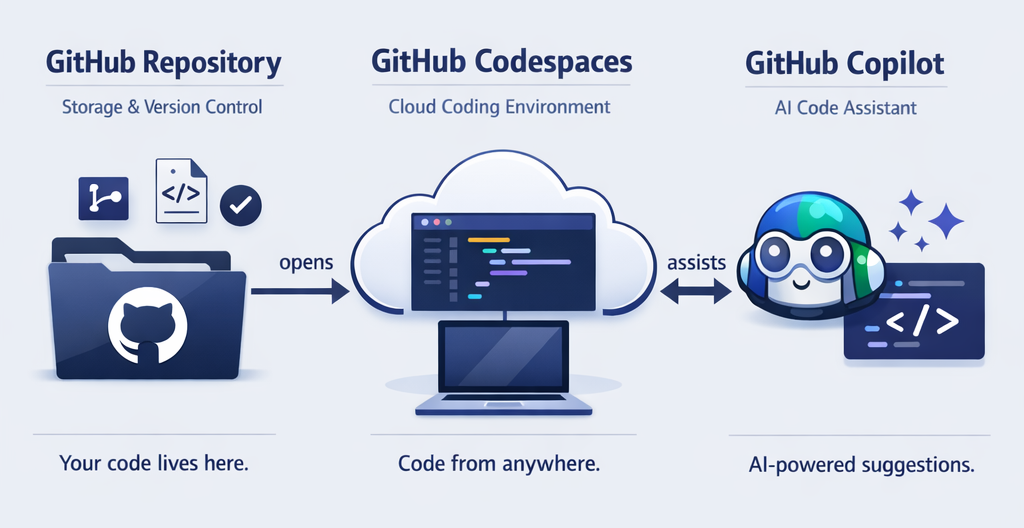
Why GitHub, GitHub Codespace, and GitHub Copilot?
Meet your AI research partner
Ask
Get answers, explanations and quick help
Plan
Agree on an approach before anything changes
Agent
Let AI write, run and fix code for you
- Which mode when?
- Plus API access to a large language model (LLM) for summarising and categorising textual data at scale
If AI can plan and write the code for me, …
- Why do I need to learn coding?

The more you know, …
- the better you can stay on top of everything
Otherwise, you won’t notice any wrong direction
AI might take you to — and won’t be able to correct it in time
Story behind Jupyter notebook
- Embedded in the name Jupyter are letters representing
- three major data science programming languages:
- Python, R, and Julia
- three major data science programming languages:
- Julia, a high-performance language, is a topic for another day
R
- a programming language specially designed for statistical computing
- has become very user-friendly for data analysis and visualization since its tidyverse era
Python
- a general-purpose programming language widely used for data analysis and machine learning (ML)
- has become the undisputed industry standard due to an unmatched ecosystem of libraries (aka. packages) that provide pre-built functions for many tasks
- Pain point of using Python:
- Traditional methods to install packages can lead to dependency conflicts and version mismatches
marimo
- marimo is a reactive Python notebook
- especially friendly to beginners due to:
- handling packages installation and environment setup smoothly under the hood
- especially friendly to beginners due to:
Open-source packages on GitHub
- Powerful packages are freely available on GitHub
- The challenge: Buried among numerous poorly maintained/poorly documented packages on GitHub

Adopting Open-source Resources
- Reliance considerations:
- Abandoned projects?
- Organizational backing (e.g., polars)
vs. Individual developer - Active development:
- Last commit
- Watch | Custom | Releases, Issues, Security alerts
The month after this workshop
- Recommendation:
- Simply keep on integrating AI into your workflow on a daily basis
Getting ready
- A preliminary self-learning pack gets you ready before the Workshop:
- Python basics in Jupyter
- Markdown
- GitHub Codespaces
- Nothing to install — everything runs in an updated modern browser
What past participants say
- “The workshop is beginner-friendly and gives you a chance to try the tools yourself rather than just learning about them in theory.”
- “Extremely well set up and helpful, would have liked more time on the day or spread over a day and a half.”
English is the new programming language
- Your productivity is limited only by how clearly you can explain your problem to AI